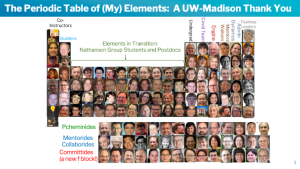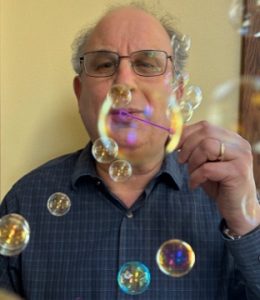
On May 1, 2026, the Learning Studio at the Department of Chemistry didn’t feel like a lecture hall. It felt more like a playground where curiosity, laughter, and a little bit of water were not just allowed, but required.
People arrived with water bottles and were told to “prepare to get a bit wet” as Professor Nathanson delivered his final seminar after 38 years at UW–Madison. The room carried the weight of a long career, but the atmosphere was anything but heavy. It felt lively, kinetic, and engaging, much like the classrooms where he spent decades teaching classes from general chemistry to upper-level physical and surface chemistry.
Gil’s path to that moment stretched back through a career built on careful study and deep curiosity about the chemistry of surfaces and interfaces. After a B.S. at Yale University (‘79), a Ph.D. at Harvard University (‘85), and a postdoc at Berkeley, he joined the UW–Madison Chemistry faculty in 1988, beginning a long stretch of research, teaching, and service that would shape both the department and generations of students. Over the years, he not only taught core courses—general chemistry, physical chemistry, and advanced electives—but also helped guide the department through leadership roles, including serving as Associate Chair for Research and participating in numerous committees.
Many in the room had been part of Professor Nathanson’s history in the department. Of those years that formed his legacy, teaching made up one part, and research formed another.
At UW, Gil’s group became known for elegant experiments probing what happens when gases strike liquid surfaces. Using molecular beam scattering techniques, Gil and his students explored fleeting collisions at interfaces and the moments where molecules dissolve, exchange protons, transfer atoms, or even react with solvated electrons. These studies illuminated the chemistry that unfolds not in bulk solutions, but at the thin boundary layer where gas and liquid phases meet.
In more recent years, that work turned outward to the atmosphere. Gil’s group, in collaboration with Tim Bertram’s group, investigated reactions in sea spray mimics: tiny droplets that act as dynamic chemical reactors, helping regulate species like ozone, hydroxyl radicals, and methane. The seminar’s focus, helium evaporation from water and what it reveals about soapy molecules organized at the surface, was rooted directly in that line of inquiry.
As participants in the lecture listened to the explanation of his research, he didn’t just describe how molecules behave at surfaces. He asked the audience to look, to touch, to try. What might have been a static presentation became something shared. Conversations rippled across rows as people commented on what they observed.
And yes, people got wet.
It was the same philosophy that had guided his teaching for decades: start with something tangible, let curiosity take hold, and then build toward deeper understanding. As the crowd flowed toward the reception in the North Tower Atrium, what lingered wasn’t just the content of the talk, but the experience of it: the sense that chemistry lives at the surface and in the thin spaces where things meet, where curiosity begins, and where, for 38 years at UW–Madison, Gil invited others to explore.