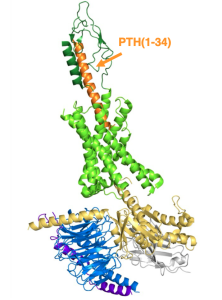
PTH(1-34); orange). The structure was determined by cryo-electron microscopy (PDB 7VVL). Image by Lauren Tran.
When many of us think of how drugs work in the body, we may first think of how a drug gets into the body, such as a pill versus an injection. In the Gellman Group at the UW–Madison Department of Chemistry, researchers are instead thinking about how a drug behaves after it reaches its target, which is critical for effective drug performance. The cells in our bodies must receive and respond to information from their environment for healthy function, and when information flow is disrupted, illness can result. Most of the information is contained in molecules that engage with receptor proteins on cell surfaces. Many medicines work by modifying information transfer at specific receptor proteins.


Traditionally, scientists have believed that once a drug molecule gets to its target, such as a receptor protein on a cell surface, that molecule must adopt just the right shape to exert a therapeutic effect. For drugs such as Forteo, Ozempic, and Mounjaro, which are peptides, that shape is a spiral (technically, an alpha-helix). New research from the Gellman Group undermines the traditional view and expands prospects for design of new drugs.
The group’s publication, Potent and biased agonists of class B1 GPCRs from a heterochiral design strategy, which appeared recently in Nature Chemistry, investigated glucagon and PTH(1–34), two peptide drugs that seem to adopt the spiral shape when they bind and activate specific receptors in the body.
The UW work started from a fundamental question: what happens if you discourage the peptide from adopting the spiral shape? You might predict that the message would be lost. “That’s what I would have guessed,” said Prof. Sam Gellman. “But the student who started this work had other ideas.” Russ Gibaldullin, Ph.D. ‘22 discovered that key message features were retained when he altered the peptide hormone glucagon to make the spiral shape less favorable. Picking up on that discovery, current Ph.D. student Lauren Tran showed that Gibadullin’s spiral-destabilizing strategy worked for a different receptor protein, which is targeted by Forteo, suggesting a general strategy.

In both cases, the message conveyed by the new peptides differed in some ways from the message of the original peptide drug. The modified peptides worked very well at activating the target receptor, but they avoided triggering certain secondary pathways. Having the ability to design drugs that will perform only helpful signaling, avoiding other pathways that might cause side effects, could ultimately lead to superior drugs.