By Kimberly Hazen
Chemists use complex compounds to create life-saving medicines, build advanced high-tech materials, and mimic natural biological systems. To make more complex compounds, synthetic chemists have relied on single-electron transfer as one of the most powerful strategies to activate and couple otherwise unreactive molecules together.
For decades, the field has been constrained by a fundamental principle of electron transfer: when two molecules compete for an electron, nature will favor transfers to the more easily reduced partner. However, work led by chemists at the University of Wisconsin–Madison, in collaboration with researchers at Colorado State University and the University of Colorado Boulder, is showing that there is a different way to think about designing reactions. Their fundamentally novel strategy, published recently in Nature, fixes a long-standing limitation in electron-transfer selectivity and could open up many otherwise inaccessible and potentially valuable coupling reactions.
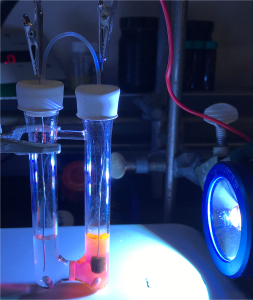
“Our catalyst works a bit differently because it actually just ejects the electron directly into solvent,” says Zachary Wickens. “This gives you, more or less, the strongest reductant and the most aggressive source of electrons you could possibly have since a free electron would rather be in basically any molecule than just on its own in solution.”

In other words, that free electron will basically attach to the first molecule it finds in solution, regardless of what that molecule is or how good that molecule is at stabilizing electrons. So, according to the new research, “anything is better than the electron freely floating in solution,” says Wickens.
As the new reaction paradigm experiments were worked out in the lab, collaborators in Colorado were working to understand the details with mechanistic investigation. A group at Colorado State University took on computational studies, while another at the University of Colorado Boulder looked at the spectroscopy to understand and reveal the chemical processes that govern this new reaction paradigm. Work at CSU was led by Dr. Robert Paton with support from the National Science Foundation-funded Center for Sustainable Photoredox Catalysis (SuPRCat).
“Our calculations reveal how the decisive selectivity emerges after electron transfer has already occurred,” says Paton. “We found that the desired reactant can escape reversal and continue toward product, while the partner that is easier to reduce is effectively recycled back to its starting material. This explains how the reaction can succeed despite the usual thermodynamic preference.”
Over the last five years, the Wickens group has been developing this particular family of catalysts that have unlocked this alternative selectivity framework. According to Wickens, “This is not just another synthetic method; it’s a new way to design redox reactions.”
The research group behind this advance consisted of Prof. Zachary Wickens, Joseph M. Edgecomb, Matthew D. Resmini, and Alissia F. Meyer of UW–Madison; Niket Manoj and Prof. Robert S. Paton of CSU; and Prof. Niels H. Damrauer and Arindam Sau of CU Boulder.