Title: Harness Macromolecules to Control Complex Electronic Structure: Physics-Informed Design, AI-Accelerated Simulations, and Quantum Computing
Abstract: Controlling electronic structure and chemical transformations in a complex and dynamical environment is fundamental to many chemical processes. For example, macromolecules such as light-responsive proteins can provide unique tools for biotechnology and chemical synthesis. In photobiocatalysis, one can bring non-native photocatalytic capabilities into proteins that do not have known native light-dependent functions, and the protein sequences can be tuned to control non-native photochemical synthesis important in biomedicine and sustainability. However, these systems pose significant challenges in computational simulations and design. First, accurate first-principles simulations of the electronic structure of macromolecules are usually computationally expensive, especially those that involve strong electron correlation. In this talk, I will discuss our computational strategies, including data-driven methods and quantum computing to tackle this challenge. Second, existing enzyme design strategies do not consider electronic excited states, and photoenzyme engineering has mainly relied on directed evolution. I will discuss our work on physics-informed computational photoenzyme design, where we combine physics-based simulations and data-driven methods to demonstrate that microenvironment tuning is a promising design strategy for photoenzymes and other light-controlled macromolecular catalysts.
Bio:
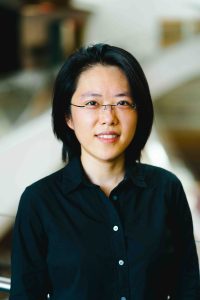
Sijia Dong is an assistant professor in the Department of Chemistry and Chemical Biology at Northeastern University.
Sijia is passionate about accelerating science using computation and automation. She received her PhD in Chemistry from California Institute of Technology in 2017, advised by Prof. William A. Goddard III, where she developed a first-principles-based and data-driven computational method to predict the structures of proteins that are crucial drug targets for many diseases. She carried out her postdoctoral research at the University of Minnesota with Prof. Donald G. Truhlar and Prof. Laura Gagliardi, and then at Argonne National Laboratory with Prof. Giulia Galli. Her postdoctoral work was to use and develop quantum chemical methods and workflows to study the photochemistry of molecules and materials. She developed machine learning methods to accelerate electronic structure theory for studying light-matter interactions.
Research in the Dong Lab focuses on developing and applying physics-based and data-driven computational methods on both classical and quantum computers to accelerate chemical discoveries, especially on leveraging microenvironment tuning to design new chemistry and physics. Sijia has been recognized with awards and honors such as the National Institutes of Health Maximizing Investigators’ Research Award (MIRA) for Early Stage Investigators, the Inter-American Photochemical Society Young Investigator Award, the American Chemical Society COMP OpenEye Cadence Molecular Sciences Outstanding Junior Faculty Award, Scialog Fellow for Automating Chemical Laboratories by the Research Corporation for Science Advancement, Emerging Investigator by the Journal of Chemical Physics, American Institute of Physics, and the Northeastern University College of Science Excellence in Mentorship Award. Sijia also co-chairs the inaugural Early Career Board of the Journal of Chemical Theory and Computation, and is a member of the Early Career Board of the International Journal of Quantum Chemistry. Research in the Dong Lab has been supported by federal funding agencies including DOE, NIH, NSF, DARPA, and the industry including Mathworks.
Host: Prof. Xuhui Huang